
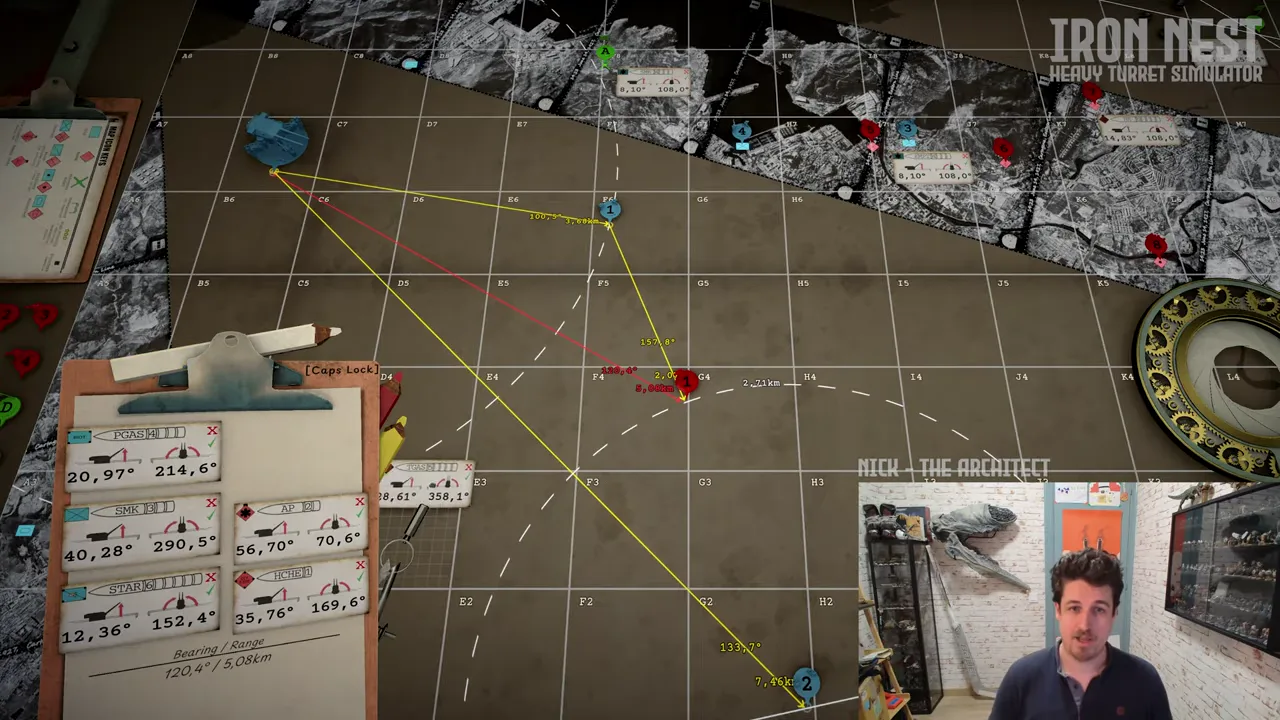
IRON NEST fields seven publicly documented shell types: HE, HCHE, AP, STAR, SMOKE, PHOSGENE, and TEAR GAS. Each round answers a different kind of fire mission, and loading the wrong one can waste a perfect firing solution — an on-target hit with the wrong shell will not always destroy the objective.
Selection starts from the mission order, not from the ammo rack. In the standard firing workflow you read the mission order, mark the Iron Nest and the target, and measure bearing and range — only then do you pick the shell, powder charges, and elevation. Within that step, check the High Command or teleprinter restriction first, then weigh target type, effect radius, nearby friendly units, and Requisition Credit cost before you load anything.
HE: the standard high-explosive round
HE is the general-purpose workhorse of the nest, with an approximately 0.27 km blast radius. It is suitable for artillery positions, infantry, mechanized targets, and civil unrest, and early missions lean on it — marked simply as H — for destructive fire.
Only callouts from your own spotters carry a bearing margin of error — roughly 0.5 degrees on either side — and the farther the target, the wider that error spreads across the ground. So when a spotter bearing is shaky and the target sits far out, one targeting guide’s rule of thumb is to step up from HE to HCHE past roughly 14.3 km and let the bigger blast radius absorb the uncertainty. Treat that as player doctrine rather than a hard stat, but it shows how the community thinks about HE’s limits.
HCHE: high-capacity area damage
HCHE is the high-capacity explosive shell, with an approximately 0.63 km blast radius — more than double the HE footprint. It is the answer to clustered targets: vehicle groups, massed infantry, or several objectives sharing one patch of grid.
The cost of that footprint is risk. The operator must check for friendly and civilian units inside the radius before firing, because HCHE will not distinguish between them. If the mission order stresses preserving allied forces, think twice before loading the big round.
AP: precision armor-piercing
AP trades blast for penetration, with an approximately 0.14 km effect radius. It is intended for bunkers, armored targets, and other hard targets that demand precision rather than area coverage.
That tight radius also makes AP the disciplined choice when a target sits close to friendly units. One gameplay demonstration shows why matching ammo to target matters: an underground bunker objective shrugged off an on-target shot until the operator switched to a high-explosive or armor-piercing round. The measurements were right the whole time — the shell was wrong. Because shot cards keep the previous bearing and elevation, following up with the correct round does not require recalculating the solution.
STAR: illumination and reconnaissance
STAR is an illumination and reconnaissance shell, not a weapon of destruction. It reveals a large area and supports target discovery and fire correction rather than dealing ordinary damage.
Fire STAR when the map is dark on intelligence: it confirms what actually sits at a grid reference before you spend lethal rounds. In the standard firing workflow, illumination and correction stand alongside destructive fire as a distinct job, and missions will call for it directly.
SMOKE, PHOSGENE, and TEAR GAS: special-purpose rounds
SMOKE is a screening shell built for concealment and battlefield control. Its mission use was limited in early builds, but operators have used smoke to shield allied troops on the ground — for example while finishing off counter-battery threats. PHOSGENE is a toxic-agent shell that attacks personnel while leaving surrounding infrastructure comparatively intact. TEAR GAS is a non-lethal irritant intended to disperse or suppress personnel. In-game, these special rounds surface under the abbreviations SMOK, PHOS, and TEAR as the game expands its target and mission systems beyond the early destructive-fire missions.
Suppression has a tactical payoff beyond dispersal. In one demonstration, a tear gas strike forced suppressed enemies to reveal themselves out of cover, confirming the triangulated position before the kill shot. When spotters only give vague directions like a plain west or west-northwest, a suppression round can turn a shaky guess into a confirmed target.
How to choose the right shell
Work the checklist in order, keeping the mission effect in view. First, the High Command or teleprinter restriction narrows what you may fire. Then match the target type to the effect: hard targets want AP, clustered targets want HCHE, general targets want HE, reconnaissance wants STAR, and screening or suppression wants the special rounds. Finally, check the effect radius against nearby friendly units and weigh the Requisition Credit cost.
Two habits separate reliable gun crews from wasteful ones. Never select a shell by maximum damage alone — HCHE covers groups but raises the friendly-fire risk, while AP is the precise option near allies. And when a new report changes the target point, measure the range and bearing again instead of reusing the previous solution. Ammunition can be replenished through the Requisition Station when the mission allows it, so spending the right round is usually affordable; spending the wrong one is not.
More ammunition is planned
Seven types are the documented core, not the ceiling. Pro Game Guides reports that the developers planned more than 30 ammunition types, though not every shell was fully revealed or usable in every version when that was written. Gameplay footage also shows operators loading cluster munitions against vehicle columns, and the same footage advises against armor-piercing shots at vessels on open water, where cluster or high-radius rounds are the better bet. Expect the rack to expand as the game develops.
Frequently asked questions
How many shell types does IRON NEST have?
Seven are publicly documented: HE, HCHE, AP, STAR, SMOKE, PHOSGENE, and TEAR GAS. Pro Game Guides reports the developers planned more than 30 ammunition types in total.
What shell should I use against bunkers?
Armor-piercing. AP carries an approximately 0.14 km effect radius and is built for bunkers, armored targets, and other hard targets that need precision.
What is the difference between HE and HCHE?
Both are explosive rounds, but HCHE has an approximately 0.63 km blast radius versus roughly 0.27 km for HE. HCHE suits clustered targets; HE is the safer pick near friendly and civilian units.
How do I restock ammunition during a mission?
Through the Requisition Station, when the mission allows it.